
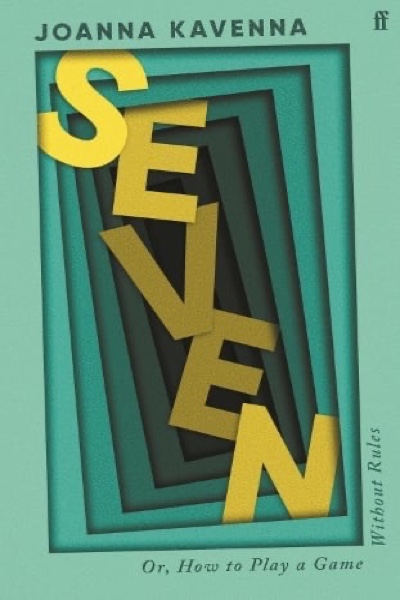
Seven
-
Scotsman Books of 2026
Financial Times What to Read in 2026
LitHub Most Anticipated Books 2026
New Scientist Best Science Fiction Books of 2026
Tatler Buzziest Books 2026
Guardian Book of the Day
‘What a writer.’ - Ali Smith
‘One of the most brilliant British writers working today.’ - SpectatorWho decides the rules of the games we play?
In August 2007, or thereabouts, a young philosopher leaves Oslo, heading for Greece, on a mission to find Theodoros Apostolakis, the head of the Society of Lost Things. Fortunately, Apostolakis isn’t lost, but everything else is: ancient libraries, entire civilisations, priceless books and a beautiful box, once used to play the world-famous game of Seven. The hunt for this small thing, among the countless lost things, becomes an absurdist quest through time and space: from the earliest human societies to the advent of AI.
Told, shared and mythologised by our narrator, along with a wild cast of dreamers, philosophers, poets, rebels and optimists, Seven is an extraordinary, uplifting journey through an ever darkening world.
EARLY REVIEWS:
‘Joanna Kavenna’s sparkling, audacious new novel...effervesces with as much energy as a geyser. […] Kavenna’s reframing of current anxieties around the harmful effects of AI on writers and artists raises important questions about the intersection between science and philosophy, the impact of digital technology on human thought. in her use of hybridity – the novel as a philosophical treatise, as a radical inquiry into the nature of being – Kavenna suggests that the form is no longer fit for purpose as a mere vehicle for narrative; now, more than ever, the novel must learn to reinvent itself. [A] wry, luminous novel, its brightness intensified by her precise, economical deployment of descriptive language, her unceasing intellectual curiosity.’
Nina Allan, Times Literary Supplement.‘Games are oases of meaning in an indifferent world…Kavenna captures this exquisitely. She is a writer of genuine elegance, intelligence and understated emotions. It is encouraging that there are those who still follow the pellucid postmodernism of Italo Calvino…’
Stuart Kelly, Spectator‘Joanna Kavenna’s latest mind-bending novel…Philosophical concepts and dizzying speculations on the nature of reality have always featured in Kavenna’s novels, but here she ramps up the comedy, interleaving erudite playfulness with characters who are as believable as they are eccentric…This novel abounds with [fun].’
Suzi Feay, Financial Times Best Books of the Week‘A book to blow the January cobwebs away…a serious, and seriously playful, book about play itself; the importance of beginning again and carrying on; of creativity, humanity, and hope. While some philosophical novels are portentous and indulgent, this one takes a palpable delight in language, is genuinely funny and warmly peopled (a chaos-causing elfin Hollywood actor very nearly steals the show). It’s subtly but unmistakably timely too.’
Stephanie Cross, Daily Mail‘Joanna Kavenna’s new novel, SEVEN, is an absolute delight, proving that the cerebral and the satirical, the poignant and the preposterous can sit easily’
Scotsman‘A surreal, time-warping quest…an uplifting odyssey’
Financial Times What to Read in 2026‘Joanna Kavenna’s two decades as a writer have seen her beat a gorgeously unconventional path through a plethora of subjects and genres, from polar exploration to motherhood to economic inequality, and from travelogue to academic satire to technological dystopia….Her seventh published book, SEVEN, is a curiously uncategorisable, protean thing: a slim, absurdist novel, but chunky with ideas….Kavenna’s philosophical rigour is leavened throughout by a generous sense of humour. Her characters are pleasingly outrageous.’
AK Blakemore, Guardian -
Nina Allan in The Times Literary Supplement
Angels and dragons
A quest for a lost board game – and a philosophical inquiryAt the start of Joanna Kavenna’s sparkling, audacious new novel, the unnamed, ungendered narrator is living in Oslo, where they are undertaking research for Alda Jónsdóttir, an Icelandic philosopher working on what she calls Box Philosophy (not to be confused with the dodgy dating theory), and in particular the knottier problems thrown up by Thinking Outside the Box About Thinking Outside the Box, henceforth mercifully abbreviated to TOTBATOTB. Invited to dinner at the home of Jónsdóttir and her husband, Guðmund Guðmundsson – an artist, “global expert on quasars” and “Viking deity” – the narrator becomes pathologically anxious about measuring up to the intellectual acumen and cultural cool of the company. The guests imbibe a minor fjord’s worth of Black Death – “an Icelandic spirit made from mashed potatoes, or something” – and end up “not only drunk but off [their] rocker”.
This peculiar and entertaining prologue – its setting a mash-up between a meeting of the Nobel prize committee and Abigail’s Party – is only the start of a story that effervesces with as much energy as the Great Geysir. In the aftermath of the ill-fated dinner party, Jónsdóttir sends the narrator on a quest to the island of Hydra to meet Theódoros Apostolakis, “a brilliant poet, a mediocre dentist and an absurdly dangerous driver” who is obsessed with the game Seven. The book helpfully provides us with the rules of this “world- famous” game, together with an image of the board on which it is played. This is carved on the underside of the box that contains its pieces, and resembles a coiled snake. “It follows the ancient path of the seven-ringed labyrinth”, Apostolakis says. The boxes and pieces are often ornate and beautifully made, the “Angels” and “Dragons” pieces especially. There are varying sets of rules by which the game can be played.
The narrator, who is no stranger to Seven, tells of playing it with their father, who died when they were only nineteen. “He was very taciturn. We had never even started talking so I could hardly claim that his death had massively interrupted our conversation. Nonetheless, my father loved to play Seven and this was how we communicated and how we passed the time.” Reacquainted with the game, the narrator discovers they have an unusual, even uncanny luck with it. They arrive on Hydra on August 27, the feast day of St Phanourios, the patron saint of lost things – a saint often depicted killing a dragon.
As well as being the curator of a Museum of Lost Things, Apostolakis has been engaged for years in a quest of his own: to recover a Seven box that was gifted to his grandfather Yannis in the aftermath of the Second World War and that has since gone missing. At the heart of this story is the massacre of civilians by Nazi soldiers at Kandanos in 1941, shot in reprisal for resisting the German invasion of Crete. “At this moment … the old world ended. The new world was crucifying, dark and mad. Everything was lost … in that one moment.” Yannis survived the killings; his sister Eleni did not. Years later, her namesake, the daughter of the New Zealand airman the siblings helped to escape, becomes the world Sevenchampion.
“Reality in those days was box-like”, observes our narrator, “a series of nesting boxes, and each time I opened one box I found another, hidden inside, and then another.” Such is Kavenna’s novel, a labyrinthine journey of body and mind. We travel from Greece to Turkey to New Zealand to India and back again to Oslo in a Seven-flavoured picaresque, the journey a simulacrum of the game itself; and all the while, we encounter metaphorical angels and dragons along the way.
One of those dragons turns out to be the Quail, a close cousin of the chess computer Deep Blue, which famously beat Garry Kasparov in 1997. The reigning Seven champion, Ashok Deo, is no match for the Quail, and its victory leaves its inventor and opponent equally traumatized. The Quail cannot be beaten because it has no consciousness – no game strategy, no mind to read, no “tells”. Kavenna’s reframing of current anxieties around the harmful effects of AI on writers and artists raises important questions about the intersection between science and philosophy, the impact of digital technology on human thought.
In her use of hybridity – the novel as a philosophical treatise, as a radical inquiry into the nature of being – Kavenna suggests that the form is no longer fit for purpose as a mere vehicle for narrative; now, more than ever, the novel must learn to reinvent itself. A new language, she shows, is needed to describe and critique a creative environment in which the very idea of human authorship is becoming contested and marginalized. Yet hope remains. After all, in spite of all fears to the contrary, the invention of photography did not abolish the painted likeness. It simply changed the artist’s way of seeing. While not refusing the concept of “story”, the author’s looping, endlessly discursive narrative throws down a challenge to traditional notions of linear storytelling. Her approach – tough-minded, sinewy – might be characterized as “difficult”. And, as so often with well-crafted “difficult” novels, Seven fully rewards the effort.
Kavenna’s obsession with boxes both literal and metaphorical is not new. In her novel A Field Guide to Reality (TLS, October 14, 2016), the protagonist, Eliade Jencks, still in mourning for her father, is bequeathed an empty box by her father-like mentor, a philosophy don in an alternative version of Oxford. The pine cones that form a leitmotif in Field Guide – an analogue of the Golden Ratio, the hidden code for life – can be seen as a precursor of the labyrinths, spirals and galaxies that keep cropping up in Seven, a reminder (as if we needed one) of the unboxable nature of reality and of the universe itself. The voices of the lost are present everywhere in Seven: muffled but distinctly audible, a force as insistent and nourishing as an underground river. As our unnamed narrator eventually concludes, our purpose lies in solving the conundrum we are presented with at birth: how to inhabit “the world of forms, as we must, and also [inhabit] the otherworld, in which such forms dissolve”.
The playing pieces belonging to the lost Seven box are described as being fashioned from the gemstone diaspore, a rare oxide of aluminium hydroxide, difficult to cut and with an unusual ability to change colour according to the light. This gem, too, recalls Kavenna’s wry, luminous novel, its brightness intensified by her precise, economical deployment of descriptive language, her unceasing intellectual curiosity, the sensuous delight she obviously takes in, among other things, Mediterranean food.
When I asked the internet if there was such a game as Seven, AI helpfully suggested that I might be looking for the card game known as sevens, a drinking game played with two dice called sevens, elevens and doubles, the World Series Game Seven, or perhaps a video game called Seven: Enhanced edition: a stealth-and-action RPG in which the protagonist is a master thief named Teriel. Of the ancient board game Seven, it could find no trace. Perhaps, as Apostolakis suggests, it has merely been lost and at this very moment – at this moment especially – lies on the blossoming verge of rediscovery.
Suzi Feay, The Financial Times
Seven — a mind-bending novel from Joanna Kavenna Board games, ancient boxes and a walk-on part for A-Ha’s Morten Harket feature in a tale that adds comedy to the author’s dizzying speculations on reality
Is there such a thing as Box Philosophy? Was the Etruscan god of wine called Fufluns? Does Greek Orthodox Saint Fanourios preside over lost things, and is his saint’s day celebrated with a cake? Does Crete contain a Cave of the Cyclops? It’s hard to suppress the urge to search online for the answers while navigating Joanna Kavenna’s latest mind-bending novel Seven. Clearly, however, there is no such board game as the one that gives the book its title, its competitions watched avidly, its grandmasters revered, its controversies passionately discussed. If it existed we’d surely have heard of undisputed world champion Ashok Deo and his regular crushing of the unlucky underdog Indrek Laar. None of those references is random; all are firmly tied into not so much a plot as an intellectual playpen.
It begins with an unnamed and ungendered narrator who is working in Oslo with Alda Jónsdóttir, one of the world’s foremost Box thinkers, on a forthcoming philosophical blockbuster called Thinking Outside the Box About Thinking Outside the Box, or TOTBATOTB. The assistant is quickly fired for being too polite, but in any case the project is terminally stalled by Alda’s inability to complete the final chapter, since it concerns establishing whether the universe itself is a box or not, ie finite or infinite. The game of Seven is also a kind of box, ancient examples of which occasionally turn up to general mystification. One is found at Gordion in Turkey, famous in history as the site of the undisentangleable Gordian knot, slashed by an impatient Alexander the Great. Archaic Seven boxes contain play pieces, and the board, in the shape of a coiled labyrinth, forms the lid. In modern times a set of rules were conjectured for the game, which involves each player aiming to get all seven of their counters to the centre spot. The first one to do so wins. The board is thus a vortex, a black hole (astronomy and questions about the nature of time and space are also functions of the novel).
Gifted player Eleni Hikaru Jones, named for a Cretan resistance fighter, suggests that the traditional rules are incorrect; the pieces at the centre should spiral back out again. “You’ve ventured deep into the labyrinth, but now you have to get out,” she reasons.
At this point it occurred to me that the game, with its helpful “Angel” pieces, seems mirrored on Dante’s Inferno; at the centre Dante and his guide must turn and spiral out again up the Mount of Purgatory, before being released (Dante at any rate) to the stars. This is not to say that particular reference was in Kavenna’s mind, just that spirals are everywhere once you look for them.
In the febrile world of professional Seven players, Eleni maintains that the main purpose of playing a game is to have fun. It’s an unpopular view, to judge by the fury aroused in the Seven community when Indrek Laar creates an AI player with the aim of crushing Ashok. Stuck in Oslo pondering infinity, Alda sends her former assistant round Europe on a variety of missions that dovetail on to his or her fascination with Seven. (The symbol / will also turn out to have philosophical significance.) The action whirls to Istanbul, Barcelona, the Greek Islands and mainland, and Jaipur. Episodes of heroic drunkenness regularly occur. Along the way the narrator meets Apostolakis, so obsessed with a lost Seven box that he creates a list and then museum of lost things; including his marbles, according to some.
Philosophical concepts and dizzying speculations on the nature of reality have always featured in Kavenna’s novels, but here she ramps up the comedy, interleaving erudite playfulness with characters who are as believable as they are eccentric. There’s the artistic duo who buy up sketches and paintings by Old Masters in order to deface them. Apostolakis is furious: “There’s no possible justification for scribbling cocks on great works of art. I mean, what are they, like, eight?” An Oslo dinner party is ruined by Ole Lauge, a tearfully unsuccessful academic who has written an ill-received tome entitled “Listen!” A later follow up, “Speak!” refines his original concept, whereupon he flashes through the rest of the novel becoming ever more eminent, advising world leaders and finally appearing with his own security detail. Idiomatic phrases in other languages point to cultural differences which mask universal concepts. In Norwegian, for example, “there are owls in the marsh” is said to equate to the English “I smell a rat”. But another gnomic reference turns out to be a quotation from the lyrics of Steve Harley’s hit “Make Me Smile (Come Up and See Me)”. And who could resist a walk-on part for a coffee-loving and entirely charming A-Ha singer Morten Harket?
Life is the real game and like Seven, for which Kavenna provides four different sets of rules, we can use a pre-existing structure or adapt our own. Food and friendship are key. Two minor characters retreat from the fray briefly: “[They] swam each morning, and the rest of the time they just lazed around . . . eating fish and vegetables, sleeping in hammocks under the orange trees. Disentangling.” The Gordian knot of existence proves easy to resolve if you remember to think outside the box. And to have fun. This novel abounds with it.
-
Buy Zed from Amazon.co.uk.
Buy Zed (US Edition) from Penguin Random House.
©2022 Joanna Kavenna